
English
Saved Blocks
Saved blocks let your users capture a group of blocks — a header, a footer, a product grid, a CTA — and re-insert it into any other template.
The editor owns the experience: a save action on every block, a searchable browser with live preview, insert-at-position, rename and delete. You own storage.
Not the same as custom blocks
Custom blocks are developer-defined block types with their own template and fields. Saved blocks are instances of ordinary blocks that end users save and reuse. The two are independent.
Quick start
The bundled browser-local provider needs no backend:
js
import { init, createLocalStorageSavedBlocksProvider } from '@templatical/editor';

const editor = await init({
  container: '#editor',
  savedBlocks: createLocalStorageSavedBlocksProvider(),
});
Entries go into localStorage under templatical:saved-blocks. Good for demos, prototypes and single-device use — they live in one browser profile, don't sync, and disappear when site data is cleared. Supply a provider for anything beyond that.
Bring your own storage
savedBlocks takes any object implementing SavedBlocksProvider — four members. list is a method; each mutation is either a function or false:
ts
interface SavedBlocksProvider {
  list(params?: { search?: string; category?: string }): Promise<SavedBlock[]>;

  create: false | ((input: SavedBlockInput) => Promise<SavedBlock>);
  update: false | ((id: string, patch: SavedBlockPatch) => Promise<SavedBlock>);
  delete: false | ((id: string) => Promise<void>);
}
false means the current user may not perform that action, and the editor hides the affordance.
A minimal REST implementation:
ts
import { init } from '@templatical/editor';
import type { SavedBlocksProvider } from '@templatical/editor';

const json = async (res: Response) => {
  if (!res.ok) throw new Error(`Saved blocks request failed: ${res.status}`);
  return res.json();
};

const savedBlocks: SavedBlocksProvider = {
  // Return everything the current user may see — scope it per user, team or
  // account here. The editor calls this with no arguments and filters in the
  // browser.
  list: async () => {
    const res = await fetch('/api/saved-blocks');
    return json(res);
  },

  create: async (input) => {
    const res = await fetch('/api/saved-blocks', {
      method: 'POST',
      headers: { 'Content-Type': 'application/json' },
      body: JSON.stringify(input),
    });
    return json(res);
  },

  update: async (id, patch) => {
    const res = await fetch(`/api/saved-blocks/${id}`, {
      method: 'PUT',
      headers: { 'Content-Type': 'application/json' },
      body: JSON.stringify(patch),
    });
    return json(res);
  },

  delete: async (id) => {
    const res = await fetch(`/api/saved-blocks/${id}`, { method: 'DELETE' });
    if (!res.ok) throw new Error(`Delete failed: ${res.status}`);
  },
};

await init({ container: '#editor', savedBlocks });
The data shape
ts
interface SavedBlock {
  id: string;            // assigned by the provider, returned from create()
  name: string;
  content: Block[];      // top-level blocks; a section carries its own children
  category?: string;     // optional — free-text grouping, drives the browser filter
  canUpdate?: boolean;   // optional — absent means allowed; set false to forbid
  canDelete?: boolean;
  createdAt?: string;    // optional — display only, never affects ordering
  updatedAt?: string;
}

interface SavedBlockInput {
  name: string;
  content: Block[];
  category?: string;
}

type SavedBlockPatch = Partial<{
  name: string;
  content: Block[];
  category: string; // "" clears the category; omitting the key leaves it
}>;idcomes from the provider. The editor never generates one; it uses whatevercreate()returns.- Rename with
update(id, { name }), recategorise withupdate(id, { category }). There are no separate methods —updatetakes a partial patch. - Ordering comes from the provider. The editor renders
list()'s order and never re-sorts; filtering narrows without reordering. Sort server-side, beforelist()returns. - Filtering happens in the editor. The search box and category filter run in memory over whatever
list()returned.list()accepts{ search, category }, but the editor never sends it — that path exists for callers drivinguseSavedBlocksdirectly (see Headless use). Which entries a user may see at all is decided inlist(). - Timestamps are display only. Each entry shows a relative "5m ago" label (from
updatedAt, falling back tocreatedAt) with the absolute date on hover. Omit both and no label renders.
Controlling permissions
Withhold a whole capability by passing false instead of a function. The editor hides what it can't do: no bookmark action when create is off (so no save flow at all), no rename control when update is off, no delete control when delete is off.
ts
const savedBlocks: SavedBlocksProvider = {
  list: async () => {
    const res = await fetch('/api/saved-blocks');
    return json(res);
  },

  // This user may add to the library but never change or remove what's there.
  create: (input) => post('/api/saved-blocks', input),
  update: false,
  delete: false,
};
Withhold a single entry with canUpdate / canDelete on it. Absent means allowed, so set them only on the exceptions:
json
[
  { "id": "1", "name": "My header", "content": [] },
  { "id": "2", "name": "Team footer", "content": [], "canUpdate": false, "canDelete": false }
]
The user can edit their own entry and only insert the shared one. The two levers compose in one direction: canUpdate: true cannot re-enable an update the provider passed as false.
A read-only library
All three false gives a curated library users browse, preview and insert from but never modify:
ts
const savedBlocks: SavedBlocksProvider = {
  list: async () => {
    const res = await fetch('/api/saved-blocks');
    return json(res);
  },
  create: false,
  update: false,
  delete: false,
};
Insertion still works — it only touches the canvas, and nothing reaches the provider. list is the one member that can't be disabled.
Not a security boundary
Hiding a control stops the editor offering an action; it doesn't stop a determined caller. Provider methods run in the user's browser, so enforce permissions server-side too — including who may read, change or delete a block in a library shared across a team.
Error handling
Any method may reject. The editor reports the failure through onError and leaves its in-memory list untouched, so a failed delete doesn't make a block vanish from the UI. The save dialog also shows the rejection message inline.
In the editor
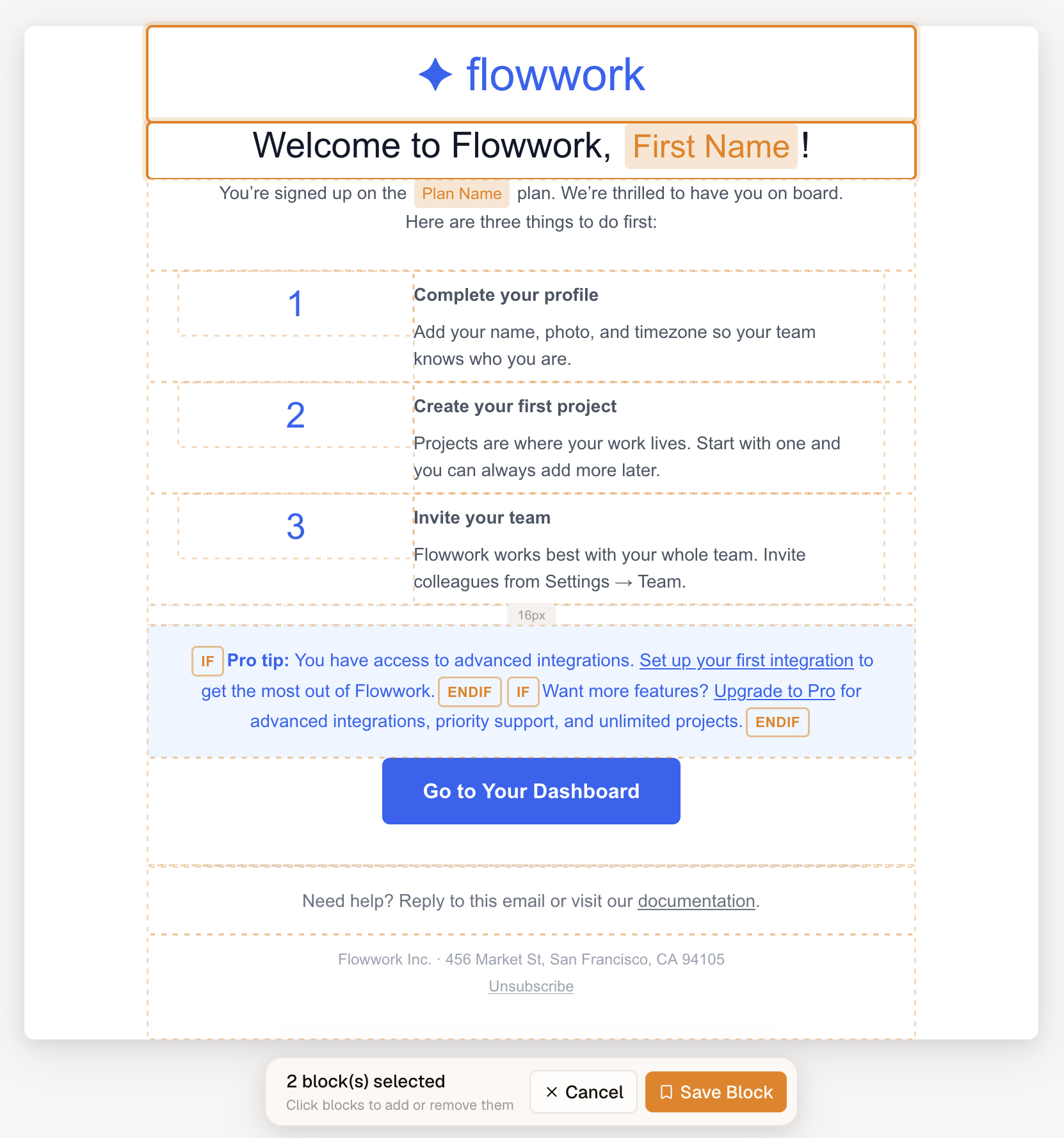
Save — selecting a top-level block reveals a bookmark action in its action bar, which starts a pick session with that block already picked.

During a session, plain clicks add or remove blocks and a bar over the canvas shows the count with Save and Cancel. Clicking inside a section picks the whole section — section children aren't individually savable, since a section carries its columns and their contents with it. Escape cancels, Enter confirms.
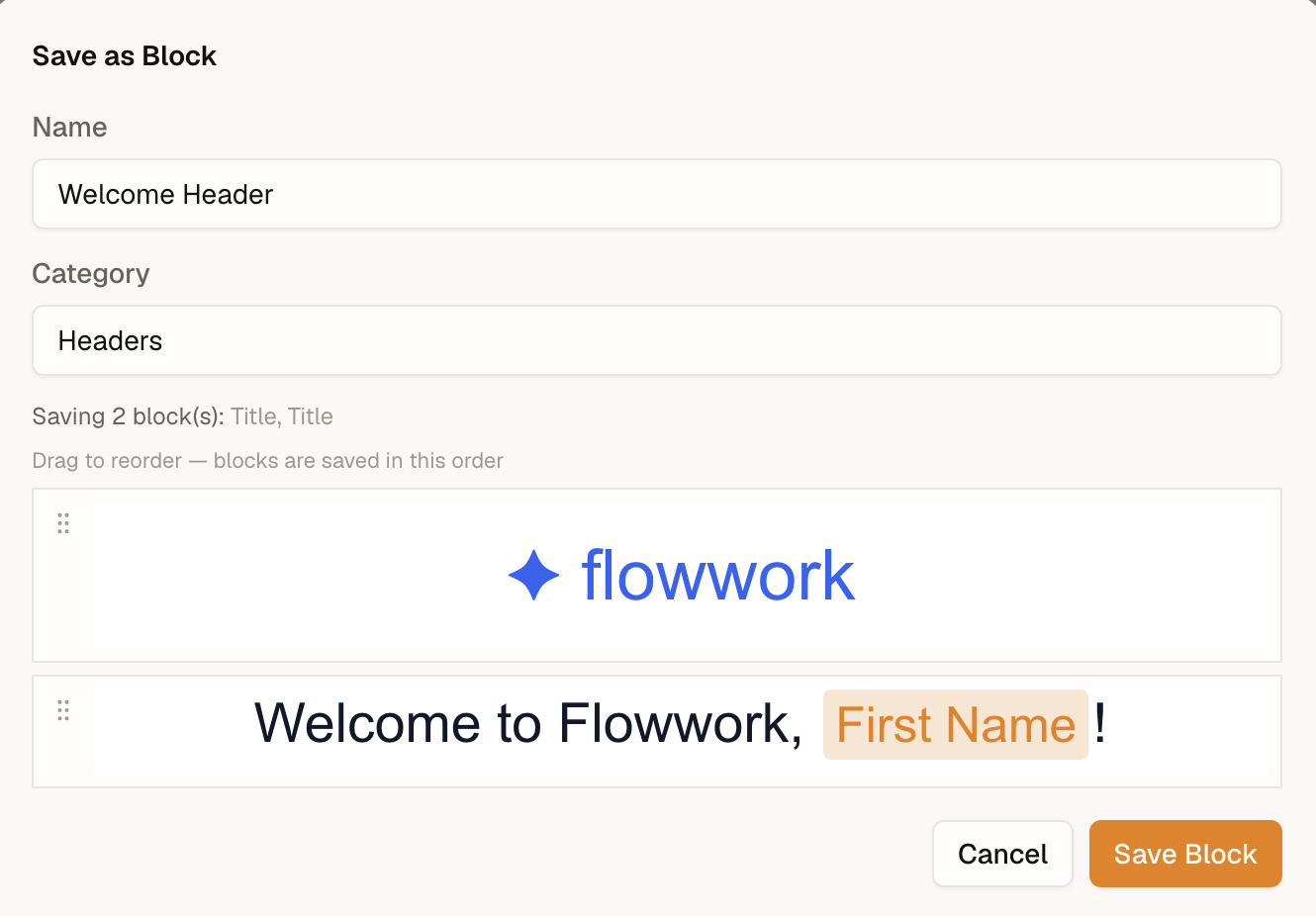
Confirming opens a dialog asking for a name and an optional category, suggesting the ones already in use. The preview lists blocks in pick order, each row draggable by its grip handle — or Arrow Up / Arrow Down with the handle focused. Whatever order the list ends in is the order the blocks are stored in.
Browse — a saved-blocks entry sits in the left rail whenever the feature is configured, opening a searchable browser with a live preview. It renders from the first paint whether anything is saved or not, so the rail never shifts. Nothing is fetched until the browser or the save dialog opens; a first open shows placeholder rows until
list()answers.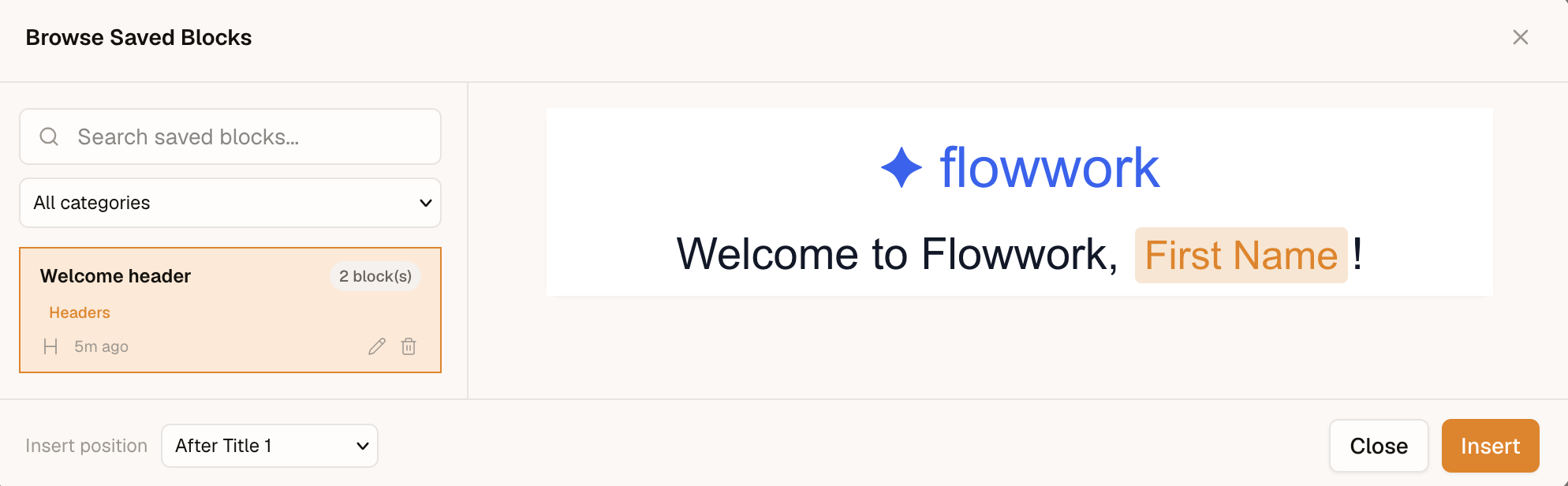
Categorise — free text, flat, optional. No folders, no nesting. The category filter appears as soon as anything is categorised and lists exactly the categories in use. Search and the filter narrow together.
Insert — choose a position (beginning, after any existing block, or end). Inserted blocks always get fresh IDs, so inserting the same entry twice never collides.
Rename / recategorise / delete — inline on each row. The edit row covers name and category together, and clearing the category field uncategorises the entry. Delete asks for confirmation.
Off by default
Omit savedBlocks and the feature is absent: no save action, no rail entry, and none of its code is downloaded. The UI is split into lazily-loaded chunks fetched only when a dialog opens.
Events
ts
savedBlocks: {
  // ...list, create, update, delete
  onCreated: (block) => {},
  onUpdated: (block) => {},
  onDeleted: (block) => {},
}
Each fires once the editor has applied the change to its own list: onCreated after a save prepends the new entry, onUpdated after an edit replaces it, onDeleted after a removal filters it out.
onDeleted carries the block, not an id
delete resolves to nothing, so the editor passes the entry it captured immediately before removing it.
A delete outside the loaded list fires no event
The captured entry has to already be in the editor's list. Deleting an id the editor never loaded — a headless caller acting on an id from elsewhere — still deletes successfully; there is nothing to pass to onDeleted, so it does not fire.
A handler that throws is caught and reported to onError — it never fails the create, update or delete that triggered it.
Headless use
The reactive state layer is exported from @templatical/core if you want your own UI over a provider:
ts
import { useSavedBlocks } from '@templatical/core';

const {
  savedBlocks, // Ref<SavedBlock[]>
  isLoading,   // Ref<boolean>
  categories,  // ComputedRef<string[]> — distinct categories, sorted
  canCreate,   // ComputedRef<boolean> — did the provider supply create?
  canUpdate,
  canDelete,
  canUpdateBlock, // (block) => boolean — capability AND the entry's own flag
  canDeleteBlock,
  load,        // (params?: { search?, category? }) => Promise<void>
  create,      // (name, content, category?) => Promise<SavedBlock>
  update,      // (id, patch) => Promise<SavedBlock>
  remove,      // (id) => Promise<void>
} = useSavedBlocks({
  provider,
  onError: (error) => {
    /* handle */
  },
});
It keeps the list in sync after each successful call — prepending on create, replacing on update, removing on delete — and re-throws after reporting to onError.
Check canCreate / canUpdateBlock / canDeleteBlock before offering an action in your own UI. Calling a withheld mutation — or one an entry forbids — rejects rather than silently resolving, so a caller can never mistake a refusal for a save.
In the playground
The Saved blocks setup keeps a library in this browser's storage: save a group of blocks, then insert, rename or delete it.